 by
by 
A paywalled report published by journalist Stephen Totilo’s GameFile has sparked great debate about the fortunes of Sony’s first-party during the PS5 generation.
Totilo has aggregated data from the platform holder’s annual financial reports, which shows declining sales of first-party games.
However, having looked at the response from fans on social media, I think a lot are overlooking crucial context and jumping straight to conclusions which support their own pre-conceived notions.
In his graph, Totilo shows the total sales of first-party games each year, from FY18 through FY25.
He points to the stark contrast in sales between FY20, the year of the pandemic, and FY24, for example, when Astro Bot and Concord launched.
First-party sales reached 58.4 million units in FY20, but dropped to just 28.9 million units in FY24 – less than half.
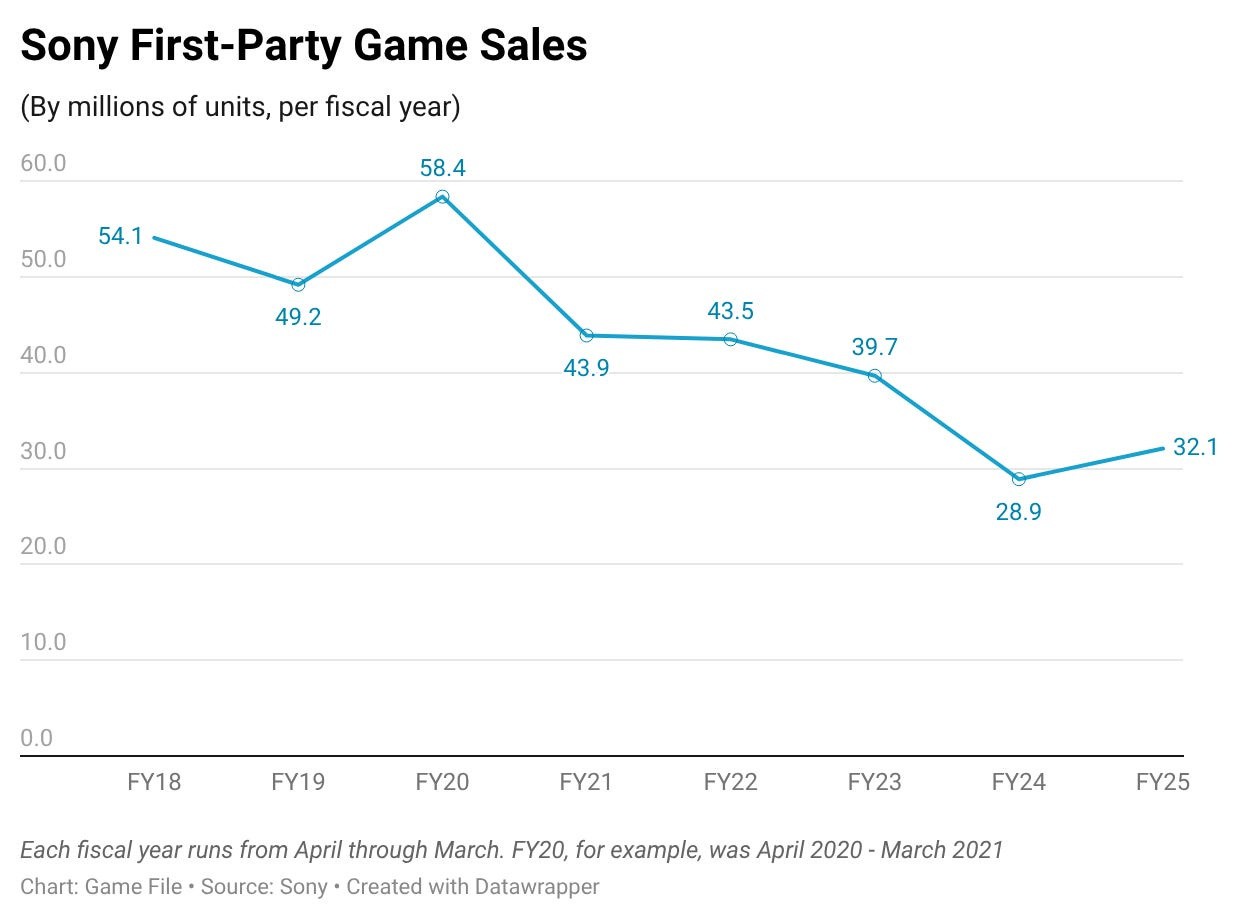
Totilo’s general hypothesis is that the sinking sales help “solidify a feeling among PlayStation observers who’ve sensed something off about the Sony gaming group’s performance”.
But while I certainly believe it’s a factor, I think this is a shallow interpretation of the data and I think there’s a lot more to it than that.
Namely the way Sony does business has changed dramatically since the PS5 launched, and it’s worth remembering this data is only taking into account the total number of units sold – and not necessarily revenue.
Here’s the important context that immediately came to my mind:
The games are more expensive
Sony increased the price of its flagship first-party games to $70 with the PS5’s launch, beginning with Demon’s Souls.
There have been fewer games
The tailend of the PS4 generation saw Sony publishing a high volume of first-party titles, bolstered by supporting initiatives like PSVR and even PlayLink. (Remember that?)
It stopped publishing indie games
Sony had a huge PSN presence during the PS3 and particularly the PS4 era, publishing many smaller, indie-style games like Everybody’s Gone to the Rapture, Alienation, et al. It ceded that market to boutique indie publishers like Annapurna Interactive, itself founded by the team that ran Santa Monica Studio’s external development programme.
The discounts don’t run as deep
Throughout the PS4 generation, Sony adopted a heavy discounting strategy. God of War’s lowest ever price on the PS Store is $9.99; God of War Ragnarok’s lowest ever digital price is $19.99. It’s a similar story for Marvel’s Spider-Man 2, which is yet to go lower than $29.39 digitally.
PS Plus Extra was introduced
In my mind, PS Plus Extra, introduced in 2022, has replaced steep discounting. First-party games get added to the catalogue after a few years, and, in response to mounting pressure from Game Pass at the time, Sony famously experimented adding Horizon Forbidden West quicker than other games. It reported flatlining sales as a result, and an impact estimated at around $85 million.
The industry has changed
Sony has repeatedly reported that the vast number of its active players are investing the majority of their time into just a handful of evergreen games, like Fortnite and GTA 5. This dramatic change in player behaviour has escalated during the PS5 generation.
The end of the PS4 generation was unprecedentedly strong
In the last year of the PS4, Sony published some of its greatest ever games, including The Last of Us 2 and Ghost of Tsushima.
I want to be very clear that I do think the overall quality of Sony’s first-party output has declined throughout the PS5 generation, although I think it’s poised to end on a high, with Marvel’s Wolverine, Santa Monica Studio’s rumoured God of War, and Intergalactic: The Heretic Prophet.
And I’d reiterate that I believe the manufacturer completely botched its approach to live service, even though I think the strategy was sound, as evidenced by player data and the enormous amount of hours being invested into evergreen titles like Apex Legends and Genshin Impact.
But I think it’s important to incorporate the above context, because I think looking at a decline in units alone only tells a part of the story.
The introduction of subscriptions like PS Plus Extra, the move away from heavy discounting, and the decision to publish fewer games in general – rightly or wrongly – makes a big difference to the data on display here.
Even bundles, which haven’t existed in this era of rising high prices, will be having a big impact on the data. Back in November 2018 you could get a PS4 with Marvel’s Spider-Man included for $200 – there’s been nothing quite like that in the PS5 era, and of course that’s having a consequence on the volume of first-party units sold.
So I think it’s a concerning trajectory, but I think you need to take into account all of the surrounding context before you can truly look at the graph objectively.
But I do ultimately agree with Totilo’s assessment: I personally don’t feel like Sony’s first-party has been firing on all cylinders this generation, and I hope these last few years of the PS5 are going to correct that – starting with today’s State of Play.